Quarterly goals for 2027: a 12-week plan you can run from January
How to set 2 or 3 quarterly goals for 2027, break them into weekly actions with a bad-week floor, and review them in week 13. Q1 dates and examples inside.
Quarterly goals are the two or three results you want by the end of the next 12 or 13 weeks, each one tied to a yearly goal and broken into a weekly action. For 2027, the first quarter can run as a clean 12-week block from Monday 4 January to Sunday 28 March, with the week of 29 March kept for review and planning the next quarter. A year is too long to feel urgent and a week is too short to see progress. A quarter sits between them, so it's where most of the real planning happens.
A yearly goal written in December is easy to agree with and easy to ignore. By February it has turned into a vague sense that you should be doing more. The quarter fixes that by asking a smaller question: what will be true on 28 March that isn't true now?
Why 12 weeks
The 12-week idea is best known from The 12 Week Year by Brian P. Moran and Michael Lennington (Wiley, 2013). Their argument is that an annual plan gives you too much room to delay, and that a shorter execution cycle creates the deadline pressure most people only feel in December. You don't have to follow the book's whole system to use the main idea.
Twelve weeks also fits the calendar well. Four 12-week blocks plus a review week after each one gives you 52 weeks. The review week matters more than it looks. Most plans fail at the handover between periods, when nobody sits down to ask what happened.
How to set quarterly goals for 2027
You need about an hour, a yearly direction and your current Wheel of Life scores. If you don't have yearly goals yet, start with how to set goals for the new year and come back.
Start from the year. Look at your yearly goals and ask which of them needs to move first. That doesn't have to be the most important one. It should be the one where three months of work would change the most.
Pick two or three, and no more. Each quarterly goal needs a few hours a week. Three goals at four hours each is twelve hours, and most weeks don't have twelve spare. If one goal is big, like a job change, make it the only one.
Write each goal so you can check it on 28 March with a yes or no. "Get healthier" can't be checked. "Walk 10,000 steps on five days a week for the last four weeks of the quarter" can. "Three months of expenses saved" can. "Finish the course and build one project with it" can.
Name what you'll give up. A quarterly goal takes hours from something. Write the trade-off next to it now, while you're calm, and keep it for the 12 weeks only. Goal trade-offs has examples.
Then break each goal into a weekly action. This is the step people skip, and it's the only one that touches Monday. The next section is about that.
Turning a quarterly goal into weekly actions
A weekly action is something you can do inside one week and tick off. It should be the same or close to the same every week, so you don't have to re-plan every Sunday.
| Quarterly goal (by 28 March 2027) | Weekly action | Bad-week version |
|---|---|---|
| Run 5K without stopping | Three runs, Mon, Wed, Sat | One 20-minute walk |
| Save one month of expenses | Transfer a fixed sum on payday, check the balance on Sunday | Check the balance only |
| Finish an online course | Two 90-minute study blocks | One 30-minute block |
| See friends more | One plan made with a friend | One message suggesting a day |
| Sleep before midnight | Phone out of the bedroom on weeknights | Phone out on two nights |
The bad-week version is the floor. Some weeks will go wrong. If you have already decided what the small version is, a bad week becomes a small week instead of a zero, and zero weeks are the ones that end plans.
If you want a full method for planning the week itself, how to plan your week covers it in about 20 minutes. For goals that are really habits, like running or sleep, link them to a habit and track it daily. How to connect habits to goals shows the chain.
The quarterly review
The review week, 29 March to 4 April for Q1, is where the system pays off. Keep it short. One sitting of 30 to 45 minutes is enough.
Re-score your Wheel of Life. Compare it with the score from the start of the quarter. Did the area you worked on move? Did another area slide while you were busy?
Then go through each quarterly goal with three questions. Is it done? If not, how many weeks did the weekly action happen? Was the problem the goal, the action or the trade-off? A goal that got its weekly action in 10 of 12 weeks and still isn't done was probably too big. A goal that got its action in 3 weeks out of 12 had a problem with the action or the trade-off, and making it bigger won't help.
Decide for each goal: keep it for next quarter, shrink it, or drop it. Dropping a goal at the review is a decision, not a failure. It frees the hours for something you want more.
Write Q2 goals the same way. Q2 2027 starts on Thursday 1 April, so either begin on Monday 5 April or treat 1 to 4 April as part of the review.
A few traps with quarterly goals
The first is making every quarter a different direction. If Q1 is fitness, Q2 is money, Q3 is a side project and Q4 is fitness again, nothing builds. Keep at least one goal that runs across quarters.
The second is setting quarterly goals without looking at the rest of your life. A quarter of 6 am runs and late-night project work can lift two areas and quietly flatten Family and Friends & social. The wheel at the review will show it.
The third is skipping the review because the quarter went badly. That is exactly the quarter that needs it most. The week-three drop has a quarterly version, around week five or six, when the novelty is gone and the deadline still feels far.
Quarterly goals in Litak
Litak has year, quarter and weekly goals in one place. Tasks in the weekly planner can connect back to quarter and year goals, so the week doesn't drift away from the bigger picture. The Wheel of Life keeps a monthly history, which makes the quarterly re-score a two-minute comparison. Every quarterly goal has a Value Exchange column for its trade-off, and the AI coach reads your wheel, goals, habits and week before it suggests a plan.
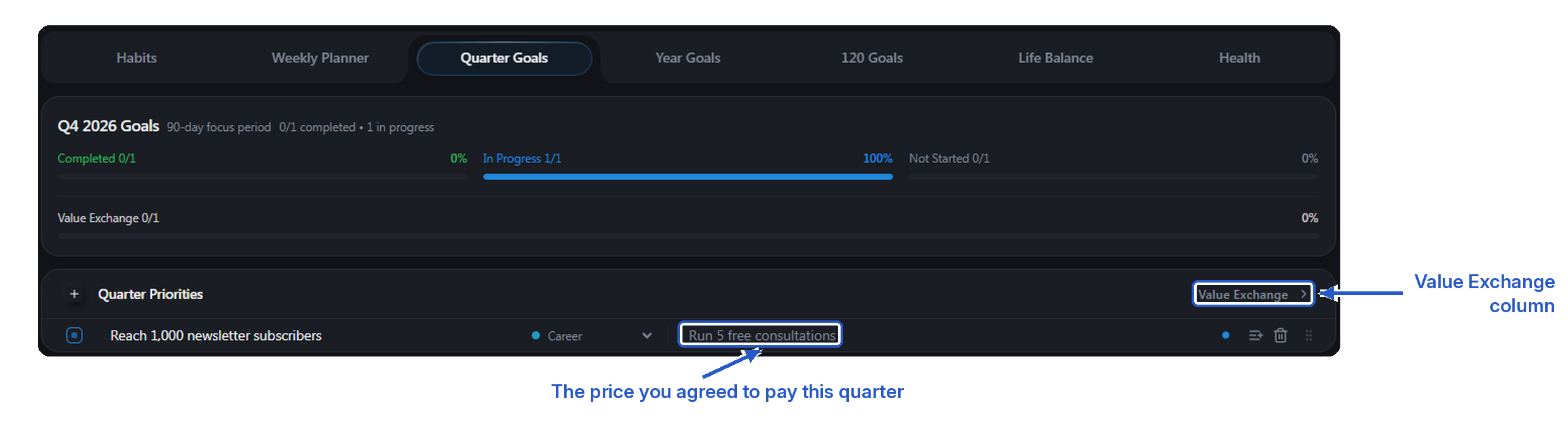
Quarter Goals in Litak: the same Value Exchange column, here with "Run 5 free consultations" as the price of a quarterly goal.
When you complete a goal that has a Value Exchange, it counts on your Dashboard. The Weekly goals card and the Quarter, Year and 120 goals tiles each have a Value Exchange bar, so you can see how many of the prices you named you actually paid. At the quarterly review, that bar on the Quarter tile is a quick answer to "did I pay what I said I would?"
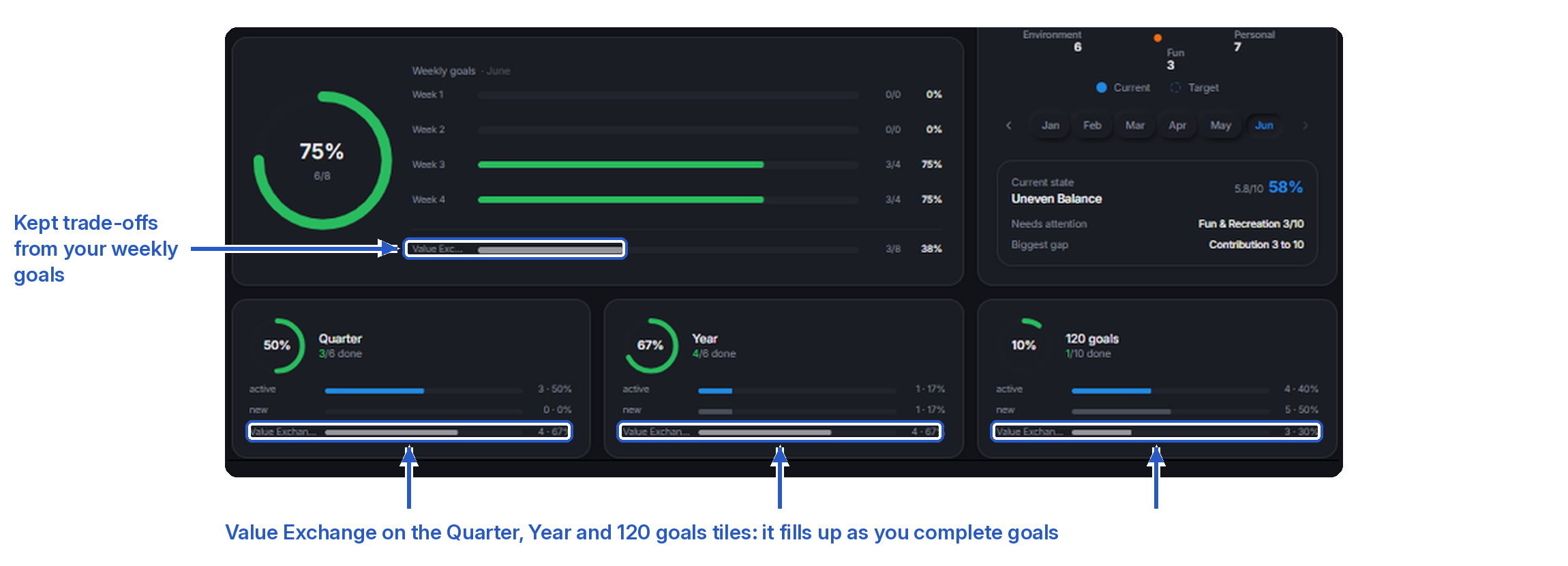
Dashboard in Litak: when you complete goals that had a trade-off, the Value Exchange bars on the weekly, quarter, year and 120 goals blocks fill up.
If you prefer paper, the free 2027 goal planner has four quarterly plans and a reusable 12-week action page. Either way, the first step is the same: score your wheel and write the two goals you want to be true on 28 March 2027.
Keep reading
FAQ
What are quarterly goals?
Two or three results you want by the end of the next 12 or 13 weeks, each tied to a yearly goal and broken into a weekly action.
When does the first quarter of 2027 start and end?
Calendar Q1 runs from 1 January to 31 March 2027. A clean 12-week block runs from Monday 4 January to Sunday 28 March, with 29 March to 4 April as a review week.
How many quarterly goals should I set?
Two or three. Each needs a few hours a week. If one goal is large, make it the only one for the quarter.
What is the 12 week year?
A planning approach from the book The 12 Week Year by Brian P. Moran and Michael Lennington (Wiley, 2013) that treats 12 weeks as the main execution cycle instead of a calendar year.
How do I review quarterly goals?
Re-score your Wheel of Life, count how many weeks each weekly action happened, and decide whether to keep, shrink or drop each goal for the next quarter.