Why Do Goals Fail? The Week-Three Problem
Most goals don't die from laziness. They die around week three, when one ignored life area pulls everything back. Here's why goals fail and how to set one that survives.
Most goals don't die from laziness. They die in week three, when a part of your life you stopped looking at starts pulling back.
You know how the first week goes. You set the goal, maybe on a Monday, maybe on the first of the month. You're up early. You track everything. Week two still feels good, just a little heavier. Then week three comes. A late night at work, a sick kid, a weekend that went sideways. You skip one day, then you skip three, and by the end of the month the goal is something you quietly stop mentioning.
If that sounds familiar, you've probably blamed yourself for it. Not consistent enough. Didn't want it badly enough. But most of the time the goal isn't the problem, and neither are you. The problem is everything around the goal.
Why do goals fail? The short answer
Goals usually fail because they're set on their own, without looking at the rest of your life. A goal that is too big or too vague, has no time slot and no plan for the hard days, and that you never check on, can survive maybe two weeks of motivation. Around week three, when motivation fades, the areas of your life you've been neglecting (sleep, health, relationships, money stress) start pulling energy back, and the goal loses. The fix is to check your whole life honestly first, pick one goal that fits it, and turn that goal into small habits and weekly tasks you can actually see.
The week-three drop: what the research shows
This isn't just a feeling. One of the best known studies on resolutions, by John Norcross and colleagues in 1988, followed people who made New Year's resolutions. 77% were still keeping them after one week. After two years, it was 19% (PubMed). In the same study, only half were still on track after three months, as Chicago Booth Review sums it up. And when psychologist Richard Wiseman tracked more than 3,000 people's resolutions through 2007, only 12% actually reached their goal a year later ([Wiseman's resolution project](http://www.richardwiseman.com/quirkology/new/USA/Experiment_resolution.shtml)).
So the drop isn't random. It's steep early on, and it comes right after the excitement wears off.
There's a hopeful side too. Researchers Hengchen Dai, Katherine Milkman and Jason Riis described the "fresh start effect" in 2014: people are more likely to go after goals at temporal landmarks like a new year, a new month, a birthday or even a Monday. That's why we keep starting again. The trouble is that a fresh start gives you a push, and a push won't carry you through a whole month.
And then there's what psychologists Thomas Webb and colleagues call the "ostrich problem." People tend to avoid checking how they're doing on their goals, especially when they suspect the news is bad. If you don't look, you can't adjust. The goal doesn't fail loudly. It just slowly fades out.
Five reasons goals fail
Most of the usual reasons are honest and simple, and you'll probably recognise at least two of them.
The first is too many goals at once. In January it's tempting to fix your body, your money, your career and your reading list in the same week. Each goal wants time and attention, and you only have so much of both. When a bad week comes, they all lose together.
The second is a goal that's too vague. "Get healthier" or "be better with money" sounds fine, but it doesn't tell you what to do on Tuesday at 7 p.m. This is also why SMART goals fail more often than people expect. You can make a goal specific and measurable on paper and still never decide when it happens.
That's the third reason: no plan for when. A goal without a time slot competes with everything else, every single day, and the urgent stuff wins. Writing down when and where you'll do the thing ("after dinner, ten minutes, kitchen table") takes away a lot of the daily negotiation.
The fourth is no plan for obstacles. You know the bad week is coming. Overtime, a trip, a cold. If the only version of your goal is the perfect-week version, the first bad week breaks it.
The fifth is never checking progress, which is the ostrich problem again. No weekly look, no number, no honest moment. You find out the goal is dead a month after it actually died.
Discipline comes up a lot here, and it matters (there's a separate guide on how to be disciplined). But most of these reasons are about design, not willpower.
The hidden reason: your goal is fighting the rest of your life
Here's the part that most advice on goal setting skips.
A goal doesn't live in a vacuum. Say your goal is to launch a side project. You're sleeping five hours, you haven't seen your friends in a month and money is tight. For two weeks the excitement covers all of that. Then week three comes, and the tiredness, the loneliness and the money worry all come back at once. The goal didn't fail because you're weak. It failed because it was chained to three areas of your life that were already breaking.
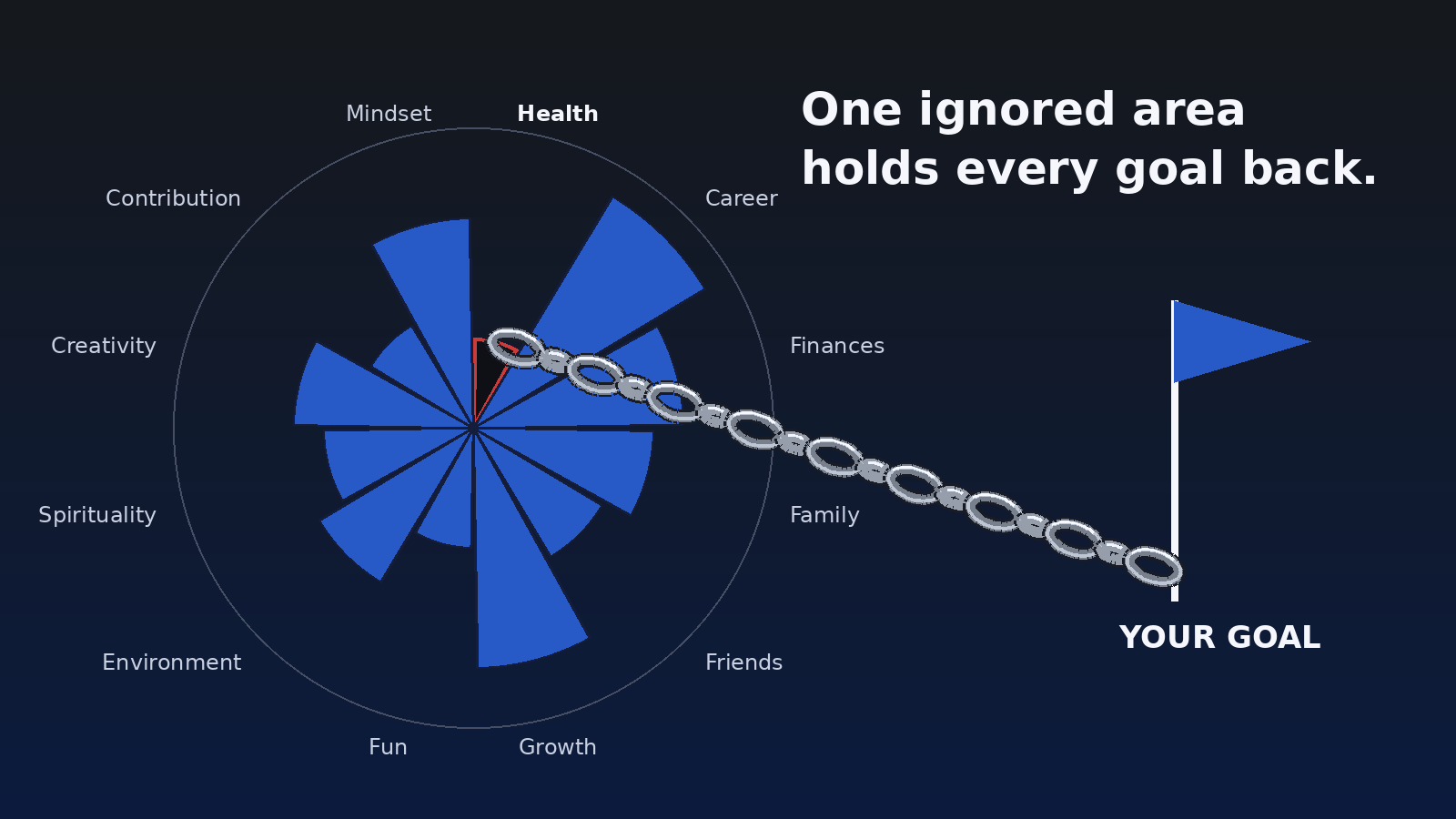
That's the week-three problem. Your goal is only as strong as the weakest area it depends on. You can keep setting better goals, with nicer wording and bigger plans, and keep losing them at the same point, because the thing pulling them down was never in the plan.
Honest check: rate your 12 areas before you set a goal
Before the next goal, look at your whole life for five minutes. The Wheel of Life is a simple way to do this. You rate each area from 1 to 10. In Litak there are 12 areas: Health, Career, Finances, Family, Friends, Growth, Fun, Environment, Spirituality, Creativity, Contribution and Mindset.
Don't overthink the numbers. Give the first honest answer, the one you'd give yourself at midnight, not the one you'd say at a dinner party. Then look at the shape. Usually one or two areas jump out. They're very low, and you know they've been low for a while.
Now ask two questions. Does your goal depend on one of these low areas? And is one of them actually the thing you should be working on first? Sometimes the honest answer is that the business goal has to wait three weeks while you fix your sleep. That feels slow, but it's faster than failing the same goal four times a year.
If almost everything scores low and you feel empty rather than unmotivated, start with how to recover from burnout instead. A new goal won't help if you're already running on empty.
Fix it: one goal, then habits, then weekly tasks
Once you've seen the wheel, set one goal. Not five. One, tied to an area that actually needs it, and small enough that a bad week doesn't kill it.
Then turn the goal into habits. A habit is the small repeated action that moves the goal when you're not feeling motivated: a twenty-minute walk after lunch, ten minutes of writing before work, checking your spending every Sunday. Give each habit a time and a place, and decide in advance what the bad-day version looks like. Five minutes counts. One page counts.
Then put it into the week. Each week, pick the two or three tasks that move the goal forward and give them real slots, next to the habits and the rest of your life. The guide on how to plan your week walks through that in about twenty minutes.
This is the order Litak is built around. You take the Wheel of Life, turn a low area into a goal, break the goal into habits and weekly tasks, and see it all in one place. The habit tracker shows whether the small things are actually happening, which takes care of the ostrich problem, because the check is already there. When a goal gets too big, the AI coach can help you cut it down. You can do the same thing on paper, though. What matters is the order: wheel, goal, habits, tasks.
Why do I keep failing my goals? What to do after a slip
If you've failed the same goal more than once, it's easy to decide something is wrong with you. Usually it's simpler than that. The goal kept meeting the same pressure at the same point, and nothing in the plan changed.
So after a slip, don't start over from zero with a bigger promise. Look at what actually happened in the week it broke. Which area pulled you away? Work? Sleep? A family thing? That's information, not failure. Shrink the habit to its bad-day version, put it back into this week, and add one thing that supports the area that broke it.
And try not to miss twice. One missed day is normal. Two in a row is where a habit starts to disappear. You don't need a Monday or a new month to restart. The fresh start effect is real, but you can make tomorrow morning your landmark.
Start again from the wheel
Next time you feel the urge to set a big new goal, wait a few minutes and score your 12 areas first. Look at which ones are low. Then pick one goal that fits the life you actually have right now, give it a habit with a time on it, and look at it again every week. When week three comes, you'll see it coming.
You can take the Wheel of Life for free at litak.io. Just sign in with Google. Start from the wheel and then set the goal.