How to Plan Your Week: A 20-Minute Balanced Method
How to plan your week in 20 minutes: a short weekly review, an honest Wheel of Life score, 3 outcomes, habits and buffer time, plus a 2-minute daily check that keeps the plan alive.
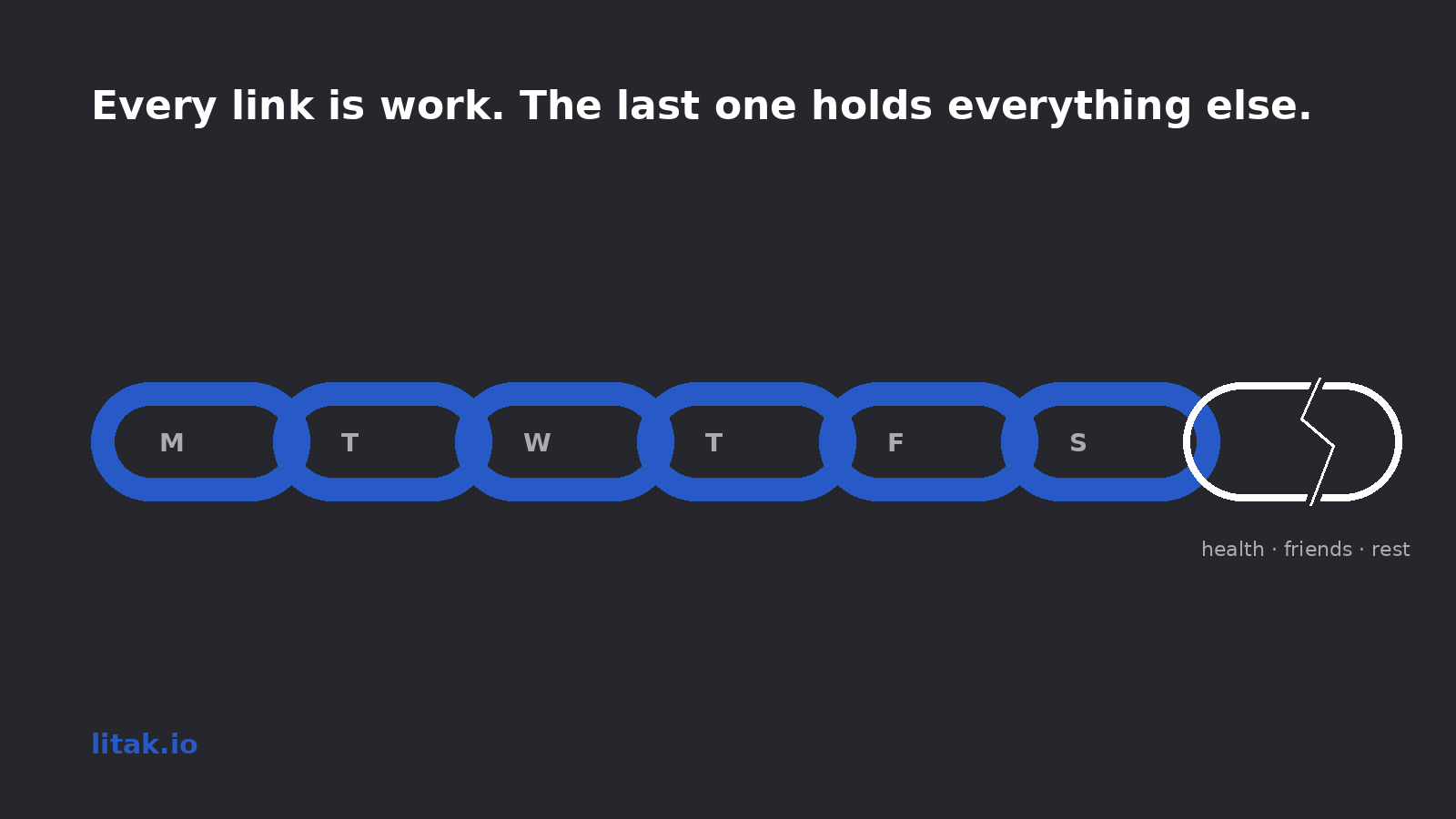
Most weekly plans don't fail because you're lazy. They fail because they were only ever a plan for your job.
Sunday evening. You open a planner, or a notes app, or the back of an envelope, and write the week out. Finish the report. Call the client. Fix the bug. Answer the emails you've been avoiding. It looks good. It feels like control.
By Wednesday it's gone. One meeting ran long, something urgent landed, and now you're three tasks behind and quietly rewriting the plan in your head. By Friday you're not planning anymore, you're just reacting. And the gym session, the call to your parents, the book you wanted to start? They were never on the list in the first place.
That's the part nobody talks about. You can get very good at weekly planning and still end up with a life where one area eats everything else. This guide is a practical weekly planning method that takes about 20 minutes. It starts with a short look back, adds an honest check on your whole life, and only then gets to tasks.
How to plan your week (the short answer)
If you only read one section, read this one. Here's the whole process:
- Review last week with five quick questions (5 minutes).
- Score your Wheel of Life and pick one or two areas that need attention this week (5 minutes).
- Choose three outcomes for the week, one of them tied to a bigger goal (3 minutes).
- Place fixed points, habits and time blocks, and leave real buffer (5 minutes).
- Do a 2-minute daily check each morning to adjust instead of abandoning the plan.
The rest of this article goes through each step and why it's there.
Why most weekly plans collapse by Wednesday
Read the popular guides on how to plan your week and you'll notice they're almost all about work. Time blocking, prioritizing tasks, batching email. Useful stuff. But they treat the week as a container for your job, and everything else gets whatever's left over.
There are two problems with that.
The first is that the plan has no slack. Every hour is assigned to a task, so the first surprise breaks it. And there's always a surprise. When a plan breaks early in the week, most people don't fix it. They drop it.
The second problem is quieter. A work-only plan makes sure work gets done and nothing else is protected. Health, friends, sleep, the side project, time with your kids. None of them has a deadline, so none of them gets a slot. Week after week, the same areas lose. You don't notice in one week. You notice months later, when you realise you haven't seen a friend since summer and your back hurts every morning.
So a good weekly plan needs two things the usual advice skips: room to absorb chaos, and a deliberate look at the parts of your life that aren't shouting for attention.
Step 1: The weekly review (5 questions about last week)
Before you plan forward, look back. Not for long. Five minutes, honest answers, no judgment. These are the weekly review questions I'd use:
What actually got done last week, and what didn't? Write both. The unfinished list is more useful than the finished one, because it shows you where your plan was unrealistic.
What drained me, and what gave me energy? A meeting, a habit, a person, a late night. Patterns show up quickly when you write this down every week.
Where did my time really go? Not where you planned it to go. If you use a calendar, scroll back through it. You may be surprised how much of the week went to things that were never on the plan.
Which area of my life did I ignore? Give it a name. "I didn't move my body at all." "I didn't call anyone who isn't a colleague."
What's one thing I want to carry into next week? A habit that worked, a boundary you held, a decision you made.
That's it. You're not writing a diary. You're collecting the information you need for the next step.
Step 2: Score your Wheel of Life and pick 1–2 areas for this week
This is where a balanced weekly plan differs from a busy one.
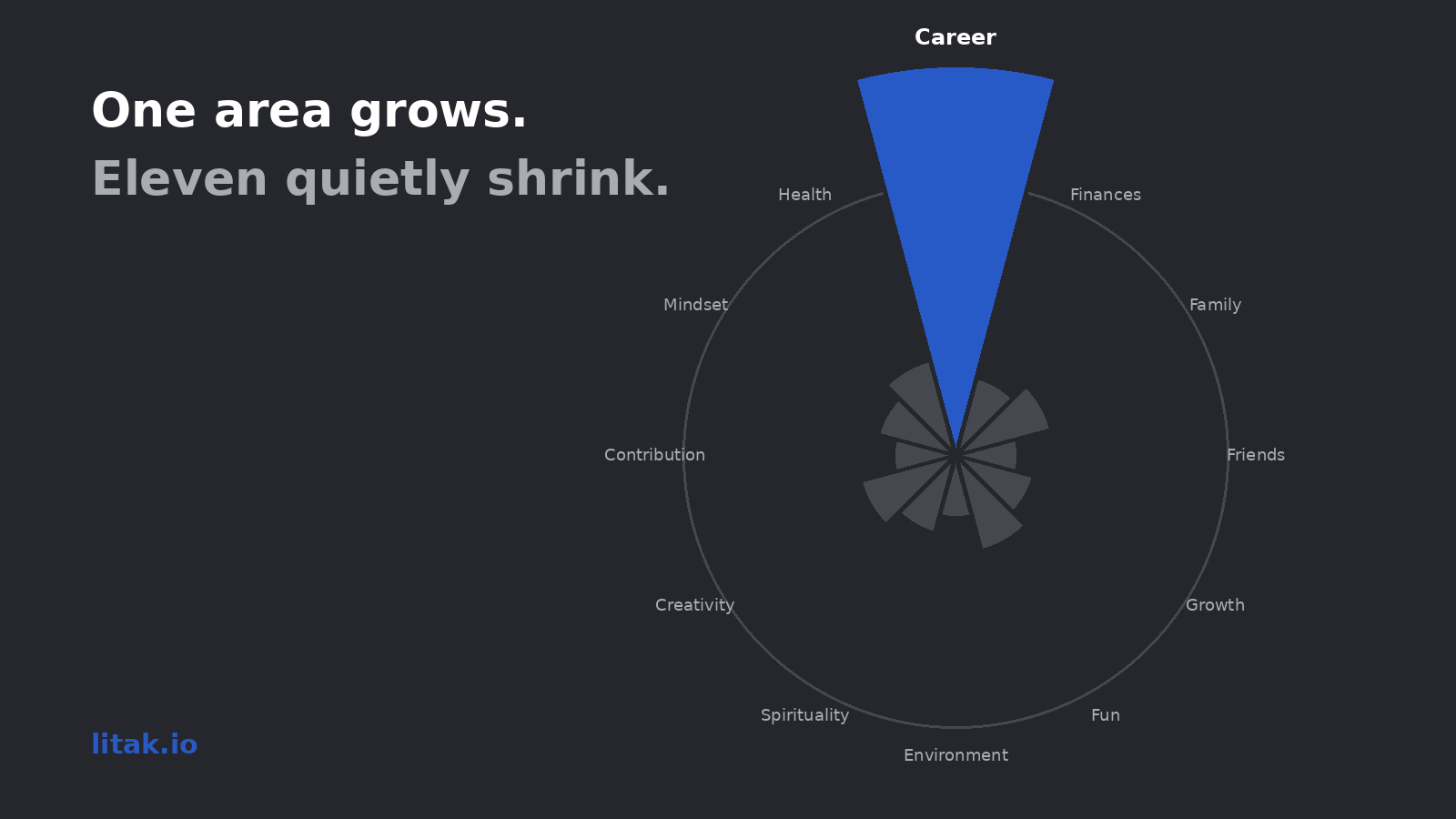
The Wheel of Life is a simple self-assessment: you rate each area of your life from 1 to 10. Litak uses 12 areas: Health, Career, Finances, Family, Friends, Growth, Fun, Environment, Spirituality, Creativity, Contribution and Mindset. You don't need to agonise over each number. Go with the first honest answer, the one you'd give yourself, not the one you'd post online.
Then look at the shape. Very often one or two areas sit high, usually Career, and several others have quietly sagged beneath them. That shape tells you more about your week than any task list.
Now pick one or two low areas for this week. Not five. One or two. If Health is a 3 and Friends is a 4, those go into the plan as seriously as your work tasks do. The point isn't to fix your whole life in seven days. It's to stop the same areas losing every single week.
If your scores are low almost everywhere and you feel flat or exhausted, start with the guide on how to recover from burnout before trying to plan a full week. Planning harder won't fix an empty tank.
Step 3: Choose 3 outcomes, one tied to your goal
Here's where most weekly planning goes wrong again: a list of thirty tasks. A long list feels productive, but it hides what matters and guarantees you'll end the week feeling behind.
Instead, choose three outcomes for the week. An outcome is a result, not an activity. "Send the proposal to the client" is an outcome. "Work on the proposal" isn't.
At least one of those three should come from a bigger goal, ideally connected to the area you picked in Step 2. If your goal for the next three months is to get your health back to a 7, this week's outcome might be "Three 30-minute walks done" or "Book the doctor's appointment I've been avoiding". Small enough to finish. Concrete enough to check off.
The other two outcomes can be work, home, money, whatever is most important right now. Everything else on your to-do list is still allowed to happen. It just doesn't get to decide whether the week was a success.
Step 4: Fixed points, habits, time blocks and buffer
Now you open the calendar. Fill it in this order, because the order matters.
Fixed points first. Meetings, school runs, appointments, anything that can't move. These are the walls of your week.
Habits next. Put in the small repeated actions that support your low areas. A 20-minute walk after lunch, ten minutes of reading before bed, a weekly call with a friend. If you struggle to stick with habits, how to be disciplined goes deeper into making them survive bad days. The short version: make them small, attach them to something you already do, and don't miss twice.
Time blocks for your three outcomes. Give each outcome a specific slot. Not "sometime Tuesday" but "Tuesday 9 to 11". Something with a time on it is far more likely to happen than something that lives on a list.
Buffer last, and don't skip it. Leave empty space on purpose. A free hour on Wednesday afternoon, a half-day on Friday with nothing assigned. This is what absorbs the meeting that runs over and the urgent request from your manager. Without buffer, one surprise knocks over everything. With it, the plan bends and keeps going.
If the calendar looks full before you add buffer, that's useful information too. It means the week was overcommitted before it started, and it's better to drop something now than on Thursday night.
Step 5: A daily 2-minute check (daily vs weekly planner)
People often ask whether they need a daily planner or a weekly planner. The honest answer is both, but they do different jobs.
The weekly plan sets direction: which areas matter, what the three outcomes are, where the habits and blocks sit. The daily check is just steering. Each morning, take two minutes and ask: what's today's most important block, which habit is on today, and did anything change that means I need to move something?
If something moved, move the block into your buffer. Don't rewrite the whole week. That's the difference between a plan that bends and a plan that breaks.
Two minutes a day is enough. If it takes longer, the weekly plan probably has too much in it.
A weekly planning template you can reuse
You can do all of this on paper. A simple weekly planning template has five sections, one for each step: the review questions, your wheel scores with the one or two areas for the week, three outcomes, the calendar with fixed points, habits, blocks and buffer, and a small box for each day's check.
If you'd rather keep it in one place, this is what Litak's weekly planner is built for. You take the Wheel of Life, turn a low area into a goal, break that goal into habits and weekly tasks, and see the whole week laid out next to the areas it's meant to support. The habit tracker shows whether the small things are actually happening, week to week. The AI coach can help you cut a goal down to something realistic when it starts getting too big.
You don't need any tool for the method to work, though. What matters is the order: look back, look at your whole life, then plan.
Plan next week from the wheel again
The next time you sit down on Sunday evening, don't start with the task list. Start with the wheel.
Score the 12 areas. Notice which ones lost again. Pick one or two, give one of them a real outcome and a real habit with a time on it, and leave space for the week to go wrong. It'll take about 20 minutes. Next Sunday, look at the scores again and see what moved.
If you want to try it in Litak, take the Wheel of Life at litak.io. It's free, you just sign in with Google. Then plan your week from what you see, not from what's shouting the loudest.