Goal trade-offs: what you're willing to give up to reach a goal
Every goal takes hours from something else. How to pick one trade-off per goal from your strong life areas, with examples and a weekly check.
A goal trade-off is what you agree to give up so the goal gets time, money or energy. Every goal has one, whether you write it down or not. Writing it down before you start, in one specific line like "two TV evenings a week" or "weekday takeaway", is the difference between a goal that has room in your week and a goal that has to fight for it every day.
Most goal-setting advice stops at the goal. Make it specific, give it a deadline, break it into steps. All fine. What it skips is the question of where the hours come from. A week has 168 of them, and on 1 January every one is already spoken for by work, sleep, people, chores and habits you don't think about. A new goal doesn't get fresh hours. It gets hours taken from something else.
Why goals need a trade-off
Economists call this opportunity cost: the value of the next best thing you didn't do. You don't need the theory. You need to notice that "go to the gym three times a week" means three evenings or mornings that used to be something. If you don't pick what gives way, the week picks for you. And the week tends to protect the old, comfortable thing and drop the new, effortful one.
That is a big part of the week-three drop described in why goals fail. Motivation covers the gap for a couple of weeks. Then a late night or a sick kid arrives, and there's no slot that was cleared on purpose, so the goal is the first thing to go.
A written trade-off also does something quieter. It tells you whether you want the goal. If you can't name anything you'd give up for it, it might be a wish, and a wish list is a fine place for it.
What you can trade
Almost every trade-off comes from one of a few places. Seeing them listed makes it easier to find one that doesn't hurt the areas you care about most.
| What you give | Example trade-off | Watch out for |
|---|---|---|
| Time from passive leisure | Two TV or scrolling evenings a week | The easiest trade, and the one people overestimate |
| Money | No weekday takeaway, the saving goes to a course | Write the amount, not "spend less" |
| A lesser goal | Pause the language app until March | Pausing is a choice; drifting away isn't |
| Comfort | Get up 30 minutes earlier on three days | Only works if you also move bedtime |
| Social time | Skip one of the two regular weekly drinks | Check your Friends & social score first |
| Perfection elsewhere | Simpler dinners, a less tidy flat | Fine for a quarter, maybe not for a year |
| Sleep | Nothing | Don't trade sleep; it pays for every other goal |
The last row is a firm opinion. Plenty of plans quietly assume shorter nights. They hold for a week or two and then the whole plan goes with them.
How to choose a trade-off that holds
Use the Wheel of Life to decide where the cost comes from. Score the 12 areas from 1 to 10. Your goal should push up a low area. The trade-off should come from an area that is fine, or from time that doesn't feed any area at all, like the third hour of scrolling.
Trade from strong areas, not weak ones. If Friends & social is at 3, don't pay for your fitness goal with the only evening you see people. If Fun & recreation is at 8 because you watch a lot of series, that's where the hours are.
Keep it to one trade-off per goal. Two or three cuts at once feel heroic in January and miserable by February.
Make it small enough to check. "Less phone" can't be broken, so it can't be kept either. "No phone in the bedroom on weeknights" can.
Put a time limit on it. A trade-off for one quarter is easier to agree to than a trade-off for life. At the end of the quarter you decide whether to keep it. A 12-week quarter is a good length for this.
Examples of goals with their trade-offs
These are written the way they'd look on a goal card. Each one has the goal, the weekly action and one line for the cost.
Goal: run a 5K without stopping by the end of March. Weekly action: three runs, Monday, Wednesday and Saturday morning. Trade-off: the Monday and Wednesday evening episodes, so I can be in bed by 11.
Goal: three months of expenses saved by December. Weekly action: move a fixed sum on payday, check the account on Sunday. Trade-off: weekday takeaway and one subscription I barely use.
Goal: finish a first draft of the side project by June. Weekly action: two 90-minute blocks, Tuesday and Thursday. Trade-off: I pause the online course I'm half doing until the draft is done.
Goal: call my parents every week. Weekly action: Sunday call at 6 pm. Trade-off: Sunday evening stays free of work messages.
The last one is a reminder that some trade-offs cost almost nothing. They just need to be named so they get protected.
When the trade-off stops working
Sometimes the cost turns out higher than you thought. You gave up two evenings, and it turns out those evenings were the only rest in your week. Your Fun & recreation score drops from 7 to 3 by February. That's useful information. It doesn't mean you failed.
Check the trade-off at the same time you check the goal, once a week. Ask two plain questions. Did I pay the cost this week? Is any other area paying for it without my say? If the second answer is yes for three weeks in a row, change the trade-off or shrink the goal. Shrinking is allowed. A goal that survives at half size beats one that gets dropped.
Trade-offs in Litak
Litak has this field on every goal. It is called Value Exchange, and it sits next to each yearly and quarterly goal, with the same column on weekly goals. You write the goal, link it to a life area and write what you are willing to give for it. The trade-off stays with the goal.
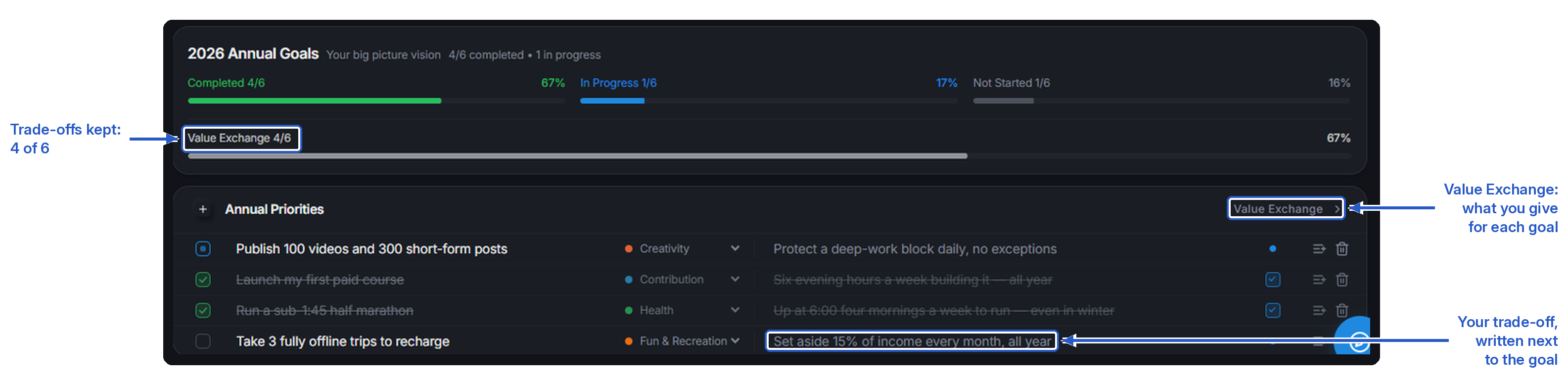
Year Goals in Litak: the trade-off for each annual goal sits in the Value Exchange column, and the bar at the top shows how many of those trade-offs you have kept.
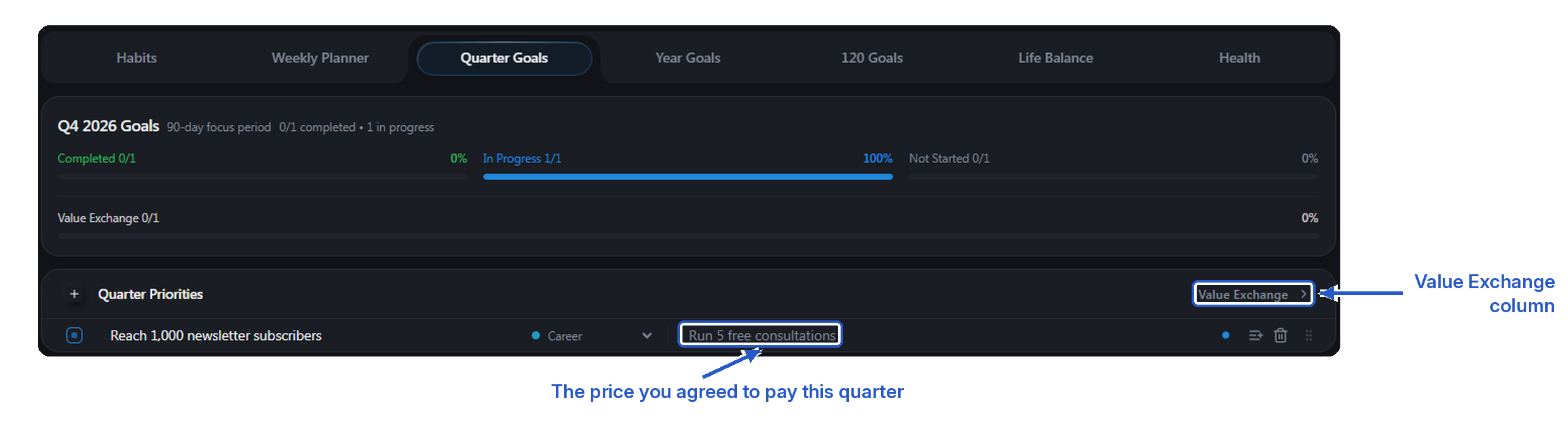
Quarter Goals in Litak: the same Value Exchange column, here with "Run 5 free consultations" as the price of a quarterly goal.
When you complete a goal that has a Value Exchange, it counts on your Dashboard. The Weekly goals card and the Quarter, Year and 120 goals tiles each have a Value Exchange bar, so you can see how many of the prices you named you actually paid.
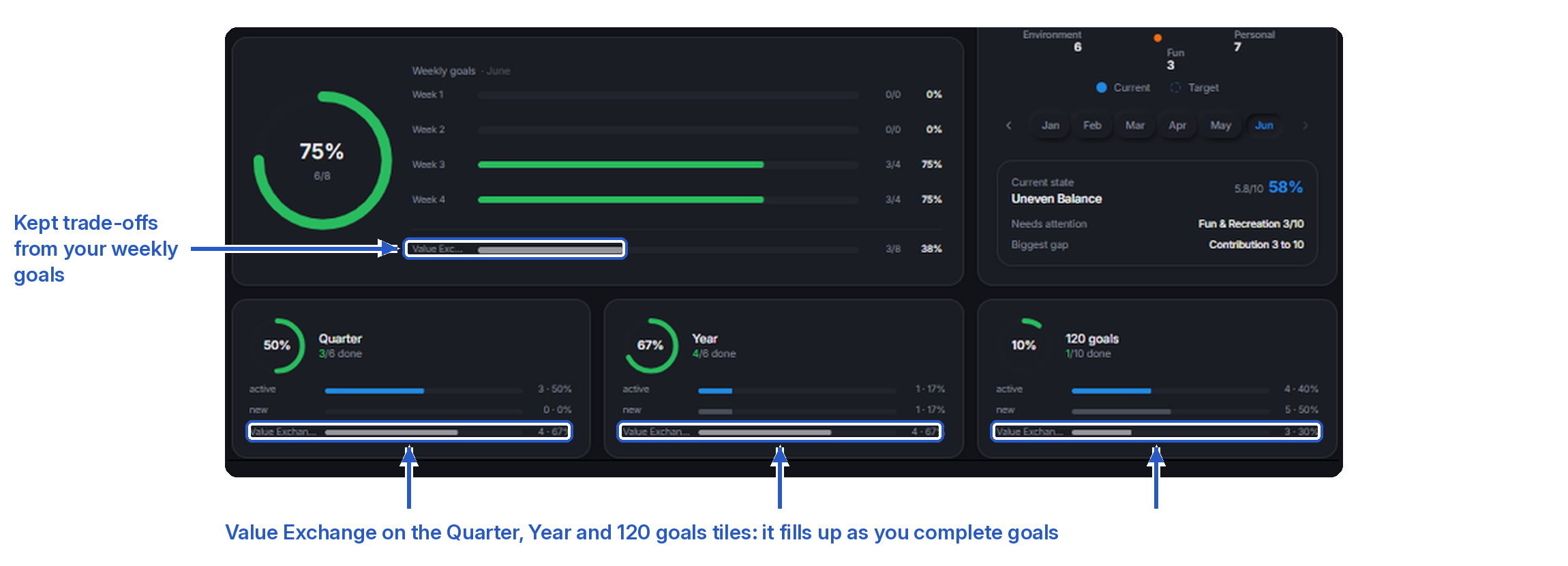
Dashboard in Litak: when you complete goals that had a trade-off, the Value Exchange bars on the weekly, quarter, year and 120 goals blocks fill up.
When you plan your week, the AI coach reads your wheel, goals, habits and week together before it suggests a plan.
The Start plan is free during beta and includes the wheel, goals, the weekly planner and up to 6 habits. Score your wheel, pick one goal from your lowest area and fill in the trade-off before you write a single task.
Keep reading
FAQ
What is a goal trade-off?
It is what you agree to give up so a goal gets time, money or energy, written as one specific line such as two TV evenings a week or no weekday takeaway.
What should I be willing to sacrifice for my goals?
Passive leisure, money from small habits, a lesser goal you pause, or some comfort. Take it from life areas that already score well. Don't trade sleep.
How many trade-offs should one goal have?
One. Several cuts at once are hard to keep past the first weeks. Set it for one quarter and review it at the end.
What if the trade-off makes another area of my life worse?
Check it weekly. If another area keeps dropping for three weeks, change the trade-off or shrink the goal.
Does Litak track trade-offs?
Yes. Every goal in Litak has a trade-off field, and the AI coach reads it together with your wheel, goals, habits and week when it suggests a plan.