How to Recover From Burnout While Still Working (Without Quitting)
How to recover from burnout without quitting your job: see what it drained with a Wheel of Life, then rebuild with one goal and a 4-week plan.
You can't take six months off. You can stop draining the same tank you're trying to refill.
It usually doesn't arrive as a crash. It arrives as a slow fade. You open your laptop and feel tired before the first email. Work you used to be proud of now feels like something you just get through. Weekends don't fix it anymore, because Sunday evening already has Monday in it. You snap at people you love over small things, then lie awake replaying the day. And when someone asks how you are, "busy" comes out automatically, because the honest answer would take too long and you're not even sure what it is.
Most advice on how to recover from burnout starts with the same sentence: take a break. Go on a long holiday, take a sabbatical, quit and reset. For a lot of people that's not an option. There's rent, a team counting on you, a mortgage, a family, a visa tied to a job. So the advice lands as one more thing you can't do, and you add a little guilt to the exhaustion.
This article is for the version of you who has to keep working while you recover. We'll look at what burnout actually is, why rest alone often doesn't fix it, and then do the part most guides skip: an honest look at which areas of your life burnout has drained, so you know where to put the little energy you have. After that we build a small, realistic burnout recovery plan, one goal and one or two habits, that fits into a working week.
1. What burnout actually is (and isn't)
The word gets used for everything from a long week to a full breakdown, so it helps to be precise. In 2019 the World Health Organization included burnout in ICD-11 as an "occupational phenomenon", not a medical condition. It describes it as the result of chronic workplace stress that hasn't been successfully managed, with three dimensions: feelings of energy depletion or exhaustion, increased mental distance from your job or feelings of negativism and cynicism about it, and reduced professional efficacy (WHO, 2019).
Those three pieces matter, because they explain why burnout feels different from ordinary tiredness. Tiredness is about energy. Burnout is energy plus distance plus doubt. You're drained, you've stopped caring in a way that scares you a little, and you've started to believe you're just not good at this anymore. That last part is the cruel one, because it makes you work harder to prove otherwise, which drains you further.
It's also worth saying what burnout is not. It's not a diagnosis you can give yourself from an article, and it overlaps with depression, anxiety and physical conditions such as thyroid problems or anemia, which can feel very similar. If you've felt hopeless for weeks, if sleep has broken down completely, or if you have thoughts of harming yourself, talk to a doctor or a mental health professional first. Everything below is a way to rebuild your life around recovery, not a replacement for care.
2. Why rest alone doesn't fix it
Here's the frustrating pattern many people describe. You finally take a week off. By day four you start to feel human again. Then you go back, and within two weeks you're exactly where you were. It feels like proof that you're broken, but it's actually proof of something simpler: you rested the person and left the system untouched.
Christina Maslach, the psychologist whose work shaped how burnout is measured, and her colleague Michael Leiter describe burnout as a mismatch between a person and their job across six areas of work life: workload, control, reward, community, fairness and values (Maslach & Leiter, 2016, World Psychiatry). A holiday doesn't change any of those. If the workload is still impossible, if you still have no say in how things get done, if your values and the work still point in different directions, the tank empties again at the same speed.
Recovery research points the same way. Sabine Sonnentag and Charlotte Fritz studied what helps people actually recover from work stress in their off hours and identified four kinds of experience: psychological detachment from work, relaxation, mastery (learning or challenging yourself in something unrelated to work) and a sense of control over your free time (Sonnentag & Fritz, 2007, Journal of Occupational Health Psychology). Notice that only one of those is "relax". The others are about having a life outside work that you're actually present in.
That's the part burnout quietly takes away. When work expands, it doesn't just eat your hours. It eats the areas that used to refill you: the friend you haven't called in two months, the sport you dropped, the hobby that now feels like another obligation, the sleep you trade for one more hour of catching up. So the real question in burnout recovery isn't only "how do I rest more?" It's "what has burnout drained, and which of those things would give energy back fastest?"
3. See what burnout drained: an honest Wheel of Life
You can't fix what you only feel as a vague grey fog. You need to see it. The simplest tool for that is the Wheel of Life: you rate each area of your life from 1 to 10, honestly, and look at the shape.
Litak uses 12 areas: Health, Career, Finances, Family, Friends, Growth, Fun, Environment, Spirituality, Creativity, Contribution and Mindset. Take ten minutes, ideally somewhere quiet, and give each one a number. Not the number you'd show your manager or post online, the one you'd admit to yourself at 2 a.m. A 4 is not a failure. It's information.
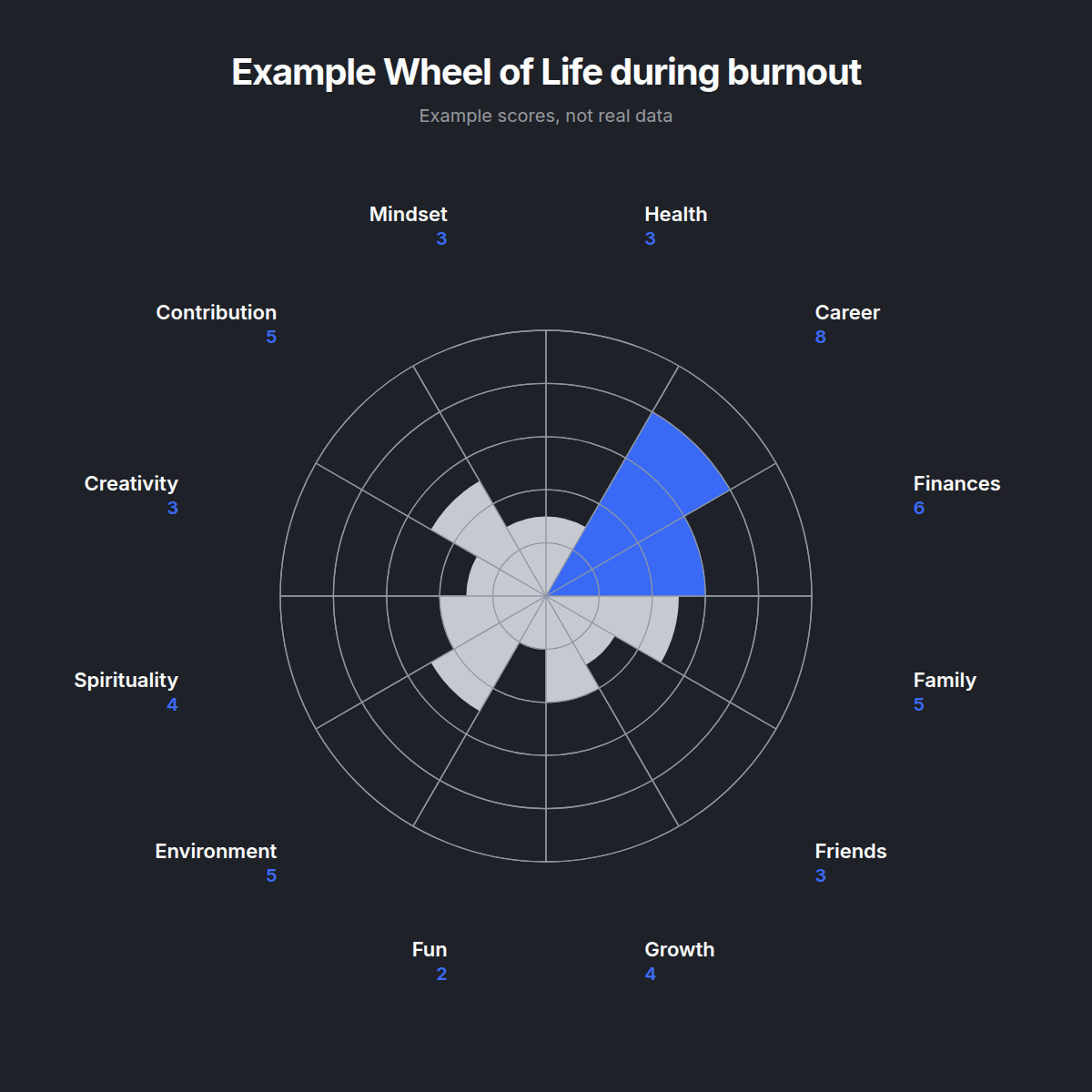
The wheel above is an example, not real data from anyone, but it shows a shape that's very common in burnout. Career sits fairly high, because that's where all the energy went. Health, Friends, Fun and Mindset have collapsed underneath it. Finances might look fine. On paper this person is "doing well", and that's exactly why nobody, including them, notices how bad it's become.
When you look at your own wheel, three things are worth noticing.
The first is your lowest area. In burnout it's rarely Career itself. More often it's Health (sleep, movement, food), Fun or Friends. Those are the areas that used to refill you, and they're the first to be sacrificed because they feel optional.
The second is the gap. A wheel where everything is a 6 feels very different from a wheel with a 9 and three 2s. The bigger the gap between your highest and lowest areas, the bumpier the ride, and the more likely the high area is borrowing energy from the low ones.
The third is the chain. Areas pull each other down. Poor sleep makes you shorter with people, so Family drops. Less time with friends means fewer moments where you laugh and forget work, so Mindset drops. A worse mindset makes work feel heavier, which pushes you to work longer, which costs more sleep. When you trace the chain, you usually find one or two areas that, if they rose even two points, would lift several others with them.
You can do this on paper, or use the free Wheel of Life at litak.io/wheel-of-life. It's free, you sign in with Google, and it saves your scores so you can compare them in a month.
4. Turn one drained area into one recovery goal
Once you see the wheel, the temptation is to fix everything at once: sleep eight hours, go to the gym, call every friend, start meditating, eat clean, set boundaries at work. That's a burnout plan for someone who isn't burned out. You're running on very little, so the plan has to be very small.
Pick one area. Choose the one where a small improvement would ripple into the others, and where you actually have some control while still working. For most people in burnout that's Health, and more specifically sleep, because almost every other area gets harder when you're running on five hours. For others it's Fun or Friends, because they've gone months without a single evening that wasn't about work or recovery from work.
Then write one goal for the next four weeks, phrased as a direction rather than a punishment. "Move Health from 3 to 5 by protecting my evenings" is a goal you can work with. "Stop being so lazy about sleep" is not. The goal doesn't need to be impressive. It needs to be honest about your current energy and specific enough that you know what it looks like.
If work itself is the root, and the wheel often shows it is, your goal can live there too, but aim it at one of Maslach's six areas rather than at "work harder". A goal like "get back one decision I control each week" or "say no to one meeting a week that doesn't need me" goes after control and workload, the parts of the job that actually feed burnout.
5. A 4-week burnout recovery plan that fits a working week
This is where people usually overreach. A recovery plan for a burned-out person should feel almost too easy. The goal in the first weeks isn't to transform your life. It's to prove to yourself that you can keep one small promise again, because burnout quietly destroys that trust.
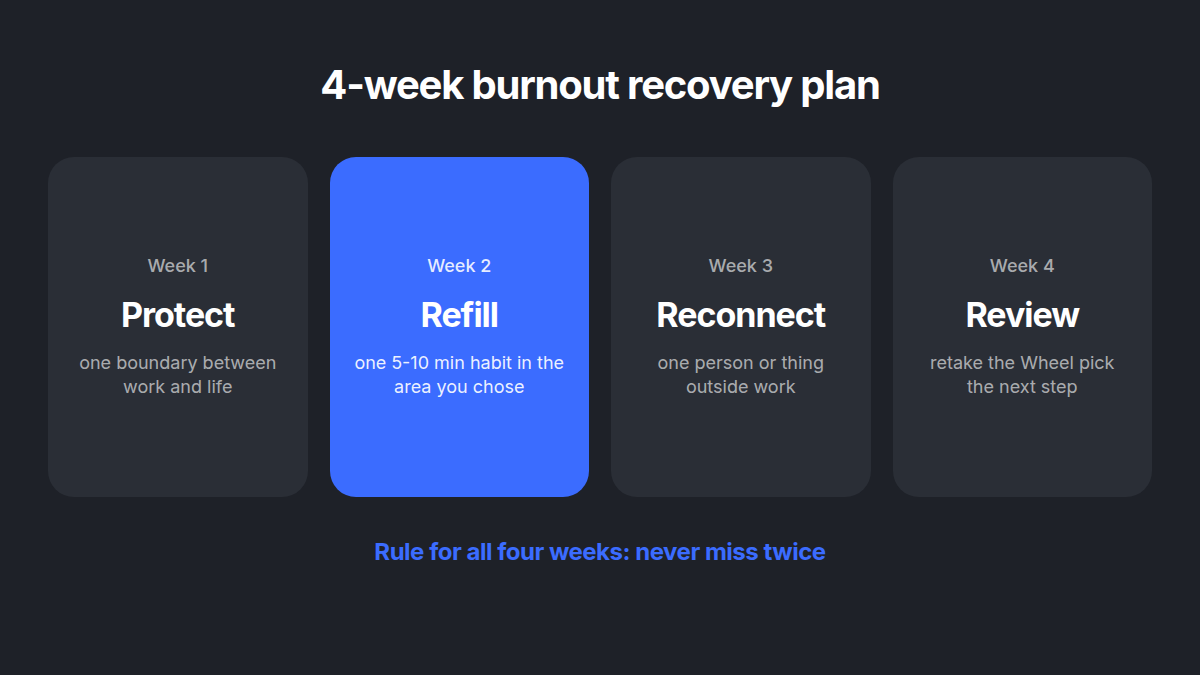
In the first week, protect one boundary. Choose a single line between work and the rest of your life and hold it. That might be a fixed time when the laptop closes, no work email on your phone after 8 p.m., or a real lunch away from your desk. This is the detachment Sonnentag and Fritz talk about, and it's the cheapest thing you can do. You're not adding anything, you're stopping one leak.
In the second week, add one refill habit in the area you chose, and start at five to ten minutes. If it's Health, a ten-minute walk after work or a fixed wind-down time before bed. If it's Fun, twenty minutes of something you used to enjoy and haven't touched in months. If it's Friends, one message a day to someone you've lost touch with. Anchor it to something you already do: after you close the laptop, after dinner, when you make your first coffee. The anchor matters more than the motivation.
In the third week, reconnect with one person or one thing outside work. Burnout narrows your world, and a narrow world makes work feel like everything, which makes every bad day at work feel like a bad life. One evening with a friend, one class, one afternoon outside. It's mastery and relaxation in Sonnentag's terms, but mostly it's a reminder that you're more than your job.
In the fourth week, review. Retake the Wheel of Life and compare the numbers with your first rating. Some areas will have moved, some won't, and one might have dropped because life happened. That's fine. Ask yourself what helped, what felt heavy, and what the next smallest step is.
Through all four weeks, follow one rule: never miss twice. You will skip a day. A deadline will land, a kid will get sick, you'll fall asleep on the couch. Missing once is life. Missing twice is the start of a new pattern, so the day after a miss, do the smallest possible version, even two minutes. If it helps to see the chain, print the free habit tracker at litak.io/habitpdf and keep it somewhere you'll see it.
6. How long does burnout recovery take?
This is one of the most searched questions about burnout, and the honest answer is that nobody can give you a number. There's no reliable research-based timeline that applies to everyone, and recovery depends heavily on how long you've been burned out, how much has changed at work, your health and the support around you. Be careful with any article that promises you'll be fine in thirty days.
What research can tell you is how long new habits take to feel automatic, which is part of recovery. In a well-known study by Phillippa Lally and colleagues at University College London, it took participants a median of 66 days for a new daily behavior to become automatic, with a very wide range from 18 to 254 days depending on the person and the habit (Lally et al., 2010, European Journal of Social Psychology). So expect weeks to months, not days, and expect it to be uneven. Some weeks you'll feel almost back to normal, and then a hard project will knock you down again.
A better question than "how long?" is "am I moving?" That's why rating your wheel again every month is more useful than counting days. If your lowest area went from 3 to 5, you're recovering, even if you still feel tired. If nothing has moved after a couple of months of honest effort, that's a sign the root is bigger than habits can fix, and it may be time to talk to your manager, HR, a doctor or a therapist about something more structural.
7. When the honest answer is that the job has to change
Recovering while still working is possible for many people, but not in every situation. If the wheel keeps showing Career as the area poisoning everything else, if the workload is truly impossible or your values and the job keep clashing, small habits will help you cope but won't solve it.
That's not a failure of your discipline. It's information, the same way a low score on the wheel is information. Use the energy you've rebuilt in these four weeks to make a clear decision instead of a desperate one: a direct conversation about workload, a request for more control over how you work, a slow and deliberate plan to change teams or roles. Quitting in the middle of burnout is often a reaction. Changing your job after you've recovered a bit of energy is a decision.
Start with one honest number
Burnout makes everything feel like one heavy grey thing. The first step of recovery is to break it into pieces you can see, and the second is to choose one piece small enough to actually move this week.
So tonight, before you scroll through another article about burnout, take ten minutes and rate the 12 areas of your life honestly. Find the lowest one, write a single four-week goal for it, and choose one habit you can do in five minutes after work. Then do it tomorrow, and don't miss twice.
If you'd like to keep all of it in one place, Litak helps with exactly that. You take the Wheel of Life, turn your lowest area into a goal, plan your week around it and track the habits that move it. It's at litak.io, free, sign in with Google. Come back in thirty days, rate your wheel again and see what moved.
This article is for general information and isn't medical advice. If you're struggling, please reach out to a doctor or a mental health professional.