How to Be Disciplined: Stay Consistent When Motivation Quits
How to be disciplined when motivation quits: find where discipline breaks, use the Aim-First framework and a 4-week protocol, plus a free habit tracker PDF.
Motivation is a mood. Discipline is a system you build once.
You know the pattern well. Monday starts strong, and by Thursday the plan has quietly disappeared. You sit down on Sunday, write everything out and promise yourself that this time will be different, the same way you did with the habit apps you downloaded and opened for about a week each. Somewhere along the way you decided the fix is more willpower, and every time it runs out you feel a little worse about yourself.
Most advice on how to be disciplined in life makes that worse, because it treats you like a broken machine. Wake up earlier, try harder, push through, and here are ten tips to go with it. It fails for a simple reason: it goes after the symptom, inconsistency, without ever asking where it comes from.
This article takes a different route. First we look at why you keep quitting. Then you rate your own life honestly, so you can see where the real problem sits and how big it is. Only after that do we fix it, with one goal, one or two small habits and a short weekly review. By the end you'll have a 4-week system you can start today in 5 to 10 minutes.
1. Why you can't stay disciplined (it's not a character flaw)
The Monday-to-Thursday collapse
Sunday night you make a plan. Monday you follow it perfectly. Tuesday is fine. Wednesday something small breaks: a late call, a bad night of sleep, a kid who is sick, a news alert you can't ignore. Thursday you skip "just once". Friday you are already telling yourself you will restart next Monday.
Nothing dramatic happened. You didn't decide to quit. The plan just quietly stopped being yours.
This isn't laziness. It's a design problem. Your plan depended on how you felt on Monday, and you don't feel like Monday every day.
Why "how to be disciplined in life" is the wrong question
Here is the uncomfortable part. Nobody is disciplined "in life". People are disciplined in specific areas.
The friend who never misses the gym might have a messy budget. The person who answers every work email on time might not have called their parents in a month. Discipline isn't one global setting you either have or don't.
So when you ask "how do I become disciplined in life?", you are asking a question that is too big to answer. It sets you up to try to fix everything at once. That's exactly what breaks on Thursday.
A better question is: where in my life does the lack of discipline actually hurt, and why there?
Hold on to that question. We'll answer it with numbers in a few minutes.
2. Self discipline when nobody is watching
Think about the last time you tried to push through on willpower alone. Maybe it was a morning workout, a side project you swore you'd touch every evening, or a simple "no phone in bed" rule. The first few days felt good, almost easy. Then one evening you were tired, or the day ran long, or something outside your control knocked your sleep sideways, and the next morning the plan felt heavier than it did on Monday. You told yourself you'd make it up tomorrow. Tomorrow turned into next week.
That moment is worth looking at closely, because it usually has less to do with discipline than it seems. When nobody sets your hours and nobody notices a skipped day, the only thing holding the plan together is how you feel. And how you feel depends on things a plan written on Sunday never accounted for: how you slept, what's happening around you, how much the rest of your life is asking from you that week.
Often there's also one area of life that's quietly sinking while you focus on the habit. Your sleep is a mess, or money is tight, or a relationship is taking more energy than you admit. You try to fix consistency on top of that, and it keeps sliding, so you decide you're the problem.
You're not. What changes things is moving the weight off willpower and onto structure, so the bad day doesn't have to rely on how you feel. The rest of this article is about building that structure, starting with finding where it actually needs to go.
3. Discipline vs motivation: the enemy is the mood, not you
Motivation is a feeling, discipline is a structure
Motivation is real, and it is useful. It is the spark that makes you write the plan on Sunday night.
But motivation is a feeling, and feelings change with sleep, stress, weather and what you read on your phone this morning. Building your life on it is like building a house on a tide.
Discipline is different. Discipline is not a stronger feeling. It is a set of decisions you made in advance, so that on the bad day you don't have to decide anything.
That is the honest answer to "is discipline better than motivation?". They aren't competitors. Motivation starts things. Discipline is what keeps going when motivation leaves.
Willpower is the most expensive tool you own
The American Psychological Association describes willpower as something that can be strengthened, but that also gets strained when you lean on it constantly, which is why its own guidance focuses on planning ahead and removing temptation rather than white-knuckling through it (APA, "What you need to know about willpower").
One of the best-studied alternatives is surprisingly simple. Psychologist Peter Gollwitzer called it an implementation intention: a plan in the form "If situation X happens, then I will do Y." His review in American Psychologist showed that this kind of if-then planning helps people act on their goals noticeably more often than good intentions alone (Gollwitzer, 1999, "Implementation intentions: Strong effects of simple plans"). A later meta-analysis of 94 studies by Gollwitzer and Sheeran confirmed the effect (Gollwitzer & Sheeran, 2006, Advances in Experimental Social Psychology).
Read that again. Not stronger intentions. Simpler plans.
So stop spending willpower on decisions that a plan could make for you.
Quit everything by week 2? That's useful information
A long history of starting and stopping isn't proof you're hopeless. It's data, and it's pointing somewhere.
People don't quit things that clearly matter to them and fit their life. They quit things that were picked at random, borrowed from someone else's routine, or aimed at the wrong part of their life.
Which brings us to the turning point of this whole article.
4. Before you fix discipline, find where it actually breaks
You aren't undisciplined everywhere. You're undisciplined where something matters less to you, or where something else is quietly broken.
If your health is a 3 out of 10, you probably have no energy. With no energy, every habit feels like a fight. That's not a discipline problem. It's a health problem showing up as a discipline problem.
The same goes for money stress that eats your focus, or relationships that drain you before the day even starts.
So before you fix anything, measure.
Take all 12 areas of your life that the wheel covers, from health, career and money to relationships, family and personal growth, and rate each one honestly from 1 to 10. Not where you wish you were. Where you are today.
You can do it on paper. Or you can take the free Wheel of Life test (free, sign in with Google). It takes a few minutes and it draws your wheel for you, so you can see the shape at a glance.
Now read the result. Start with the lowest spoke, because that's usually where the "discipline problem" really lives. Then measure the gap: write down where you want that area to be in 3 months. A 4 you want to turn into a 6 is a very different project from a 2 you want to turn into a 9. Finally, ask yourself one thing. If this area went up by 2 points, would the others get easier?
For most people, the answer points straight at one area. That area becomes your Aim. And that is where the framework starts.
5. The Aim-First Discipline framework
Most systems start with habits. Aim-First starts with where, then builds the habit around it. Four steps, in a loop.
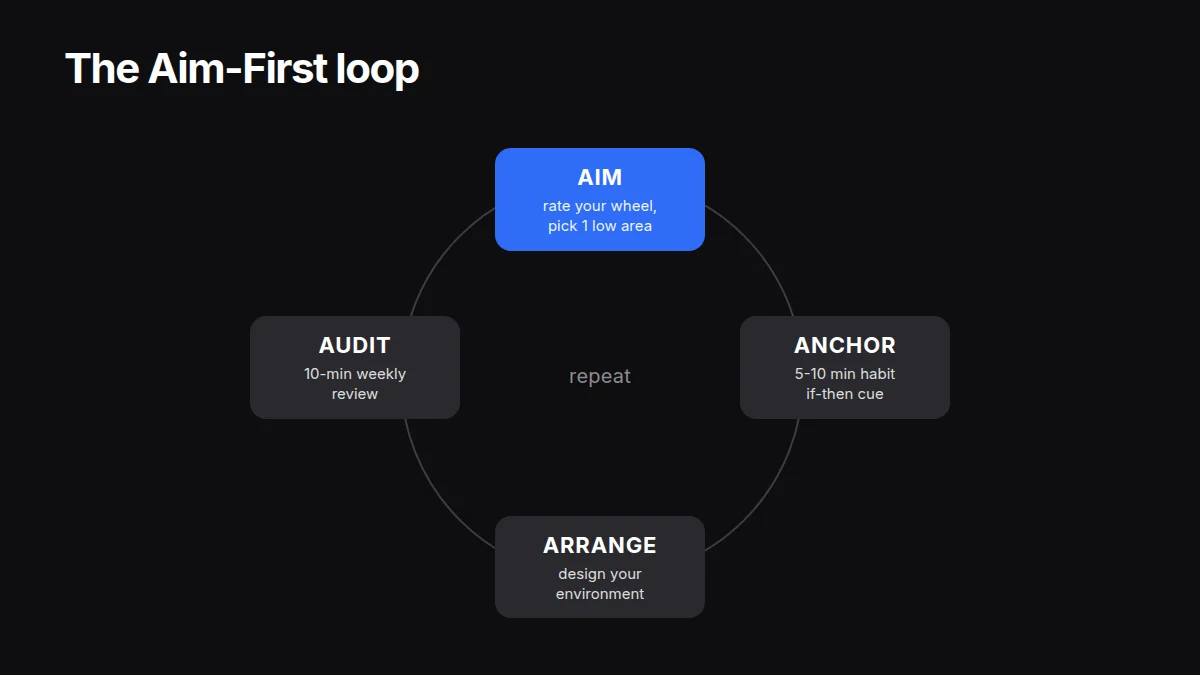
The first step is Aim. From your wheel, choose one area that is both low and important to you, and only one. If you're not sure which areas to rate, start with the 12 life areas. Then write a single goal for it for the next four weeks, something concrete and small, because "sleep 7 hours on weeknights" will carry you much further than "fix my health". Most people skip this step, and that is why their discipline has nothing to hold on to.
The second step is Anchor. Pick one habit that moves the goal and make it tiny, 5 to 10 minutes at most and even less on the first day. Tie it to something you already do with an if-then plan, like "if I pour my morning coffee, then I write my top task for the day" or "if I close my laptop after work, then I walk for 10 minutes." You're not after intensity here. You want a habit so small there is nothing to argue with, and if you need help with that, here is how to connect each habit to a goal.
The third step is Arrange, because discipline gets easier when the right thing is also the easy thing. Take friction away from the habit by leaving your shoes by the door, the book on your pillow or the document already open, and add friction to the alternative by putting the phone in another room, logging out of the app or not keeping snacks in the house. Environment design like this quietly does much of the work people usually credit to willpower.
The fourth step is Audit. Once a week, sit down for ten minutes and look at how many days you did the habit, what got in the way on the days you missed, and what you'll change. There's no guilt in it, only adjustments, and this review is what turns a plan into a system that learns. After that the loop starts again: you check the Aim, keep or adjust the Anchor and tweak the Arrangement.
6. How to be disciplined and consistent: the 4-week protocol
Here is the whole thing, week by week. Self discipline is a skill, so treat this like training, not like a test.
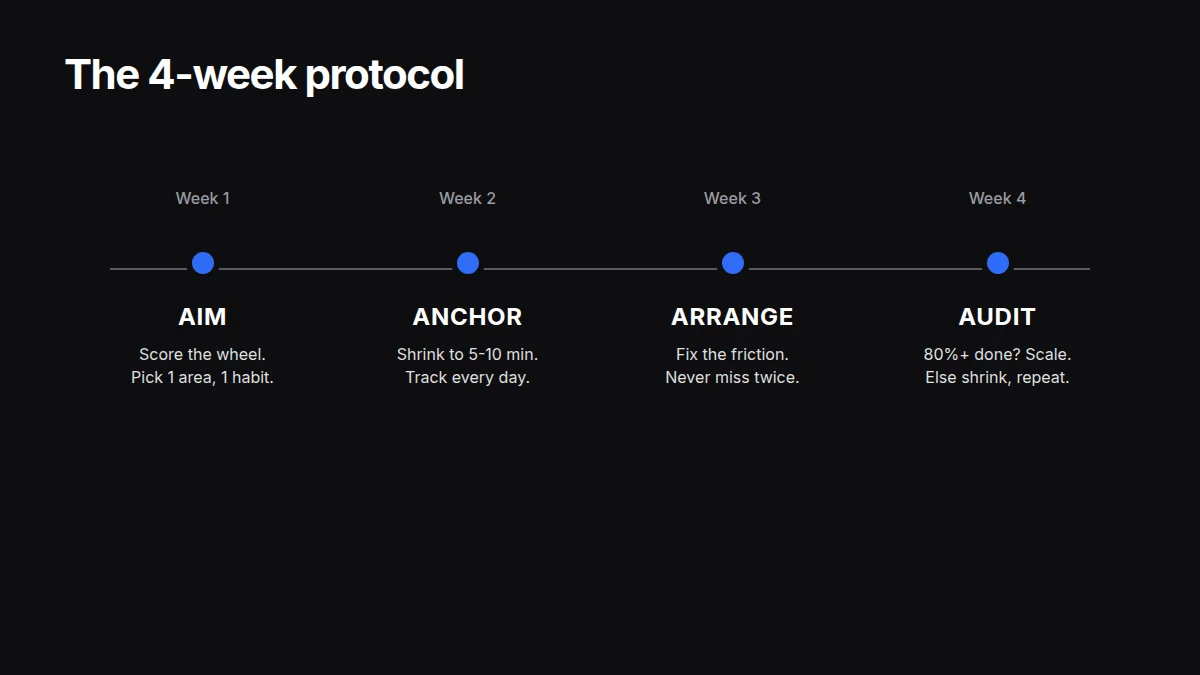
Week 1: Aim
Score your wheel honestly and pick one area that's low and matters. Write one 4-week goal for it and one habit that moves it. Then turn your wheel into a weekly plan, so the habit actually has a slot in your week.
Don't add anything else this week. Resist the urge to fix three areas at once.
Week 2: Anchor
Shrink the habit to its 5 to 10 minute version. Smaller is fine. Write the if-then plan on paper, and track every day with a plain check mark.
The check mark matters more than it looks. Seeing an unbroken row is a small reward on its own. If you want a ready-made sheet, grab the free habit tracker PDF and print it.
Week 3: Arrange
Look at the days you missed in week 2 and ask what got in the way. Then change your environment so that obstacle is gone. And adopt one rule: never miss twice. Missing one day is life. Missing two is the start of a new habit, just the wrong one.
Week 4: Audit and scale
Count your check marks for the last two weeks. Hit roughly 80% or more? Raise the habit to 10 to 15 minutes, or add a second one in the same area. Below that, don't add anything. Make the habit smaller or move it to a better cue, and run week 4 again.
A couple of situations need small tweaks. If you're a student, anchor the habit to your class schedule, say 10 minutes of review right after each lecture. If focus is a constant struggle for you, keep the habit extremely short and visible and lean on external reminders. And if focus problems show up in every area of your life, it's worth talking to a professional. For money, start with a 5-minute daily expense check instead of a full budget.
7. How to be consistent when life gets messy
Life won't cooperate for 4 weeks straight. Plan for that now.
Have two versions of every habit. A minimum version and a bonus version. Minimum: one push-up, one paragraph, one line in a journal. Bonus: the full session. On bad days you do the minimum and it still counts.
Sick days and bad nights. Do the minimum or rest deliberately, and mark it as a planned rest day. A planned rest is part of the system. An unplanned skip is a crack in it.
Travel and disruption. Before a trip, decide your travel version in advance: same cue, smaller action. "If I wake up in a hotel, then I walk for 10 minutes before breakfast."
After a miss. Don't restart on Monday. Restart on the next possible occasion, even if it is Wednesday night. Never miss twice.
Being consistent isn't about never failing. It's about how fast you come back.
8. Start today (the 1% math)
Here is a reframe worth keeping.
If you live to 80 and you are an adult for about 60 of those years, then 6 months is less than 1% of your adult life. Four weeks is a rounding error.
You can give one area of your life a rounding error.
So start today. Rate your life honestly with the Wheel of Life and find the lowest area that matters. In Litak you can turn that area into a goal, attach one 5 to 10 minute habit to it, and break the first week into small tasks, all in one place (free, sign in with Google). If you prefer paper, download the free habit tracker PDF, print it, and put your first check mark on it tonight.
That's it. No new identity, no 5 AM routine, no motivation required.
Next time: how to reset your life in 7 days.
– Volodymyr
FAQ
Is self discipline a skill?
Yes. Self discipline is a trainable skill, not a fixed trait. You build it the way you build any skill: start small, practice daily, get feedback, and increase difficulty slowly. Clear goals, if-then plans and a designed environment make it easier to practise, which is why people get noticeably more consistent with a system.
How to be 100% disciplined?
You can't, and you don't need to be. Nobody is disciplined every single day. Aim for "never miss twice": if you miss a day, make the next one count, even with the minimum version. Roughly 80% consistency over months beats a perfect week followed by quitting.
What are 7 ways to gain self-discipline?
Here are seven that work together: 1) rate your life areas honestly, 2) pick one area to improve, 3) set one small goal, 4) attach a 5-10 minute habit to an existing cue, 5) design your environment, 6) track daily, 7) review weekly and never miss twice.
How do I become disciplined and consistent?
Pick one area of life that is low and matters, set one small goal, and anchor a tiny daily habit to something you already do. Remove friction, track it with a check mark, and review it weekly. Consistency comes from a simple system you repeat, not from feeling motivated.
Is discipline better than motivation?
For long-term results, yes, but they work together. Motivation is a feeling that helps you start; it rises and falls with sleep, stress and mood. Discipline is a set of decisions made in advance, so you act even when motivation is gone. Use motivation to plan, discipline to follow through.